
Adams Mine 25
On the 25th year anniversary, take a look back at the Adams Mine protests, one of the most successful activist movements in Canada. Featuring interviews with participants in the protests, political cartoons published in newspapers, and a large archival collection of articles and propaganda from corporate interests.

January 8
This exhibition was made possible by the Department of Canadian Heritage through the Government of Canada, as well as operational funding from the Ontario Arts Council.

CURATOR'S STATEMENT
As with any ambitious project, Adams Mine 25 could not have happened without the help of our community. In particular, great thanks must be given to our TAG staff including Andrew Little, Jasmine Reil, Shannon Lawrence, and Sabrina Somersall, who gave their time, expertise, and moral support to the project. Working daily with such a passionate and committed staff is the best gift a curator could receive.
The second best gift is an engaged community, and that is exactly how this project began. Three years ago a conversation with Sue Gamble, whose photographs and paintings you see in the exhibition, reminded me that the 25th anniversary of protecting the Adams Mine site was coming up. Gamble was rightly concerned that if we didn’t remind people of the near miss the region had, then we might be doomed to repeat it.
While looking further into Canada’s most successful activist movement, it struck me how creative the key players were and how they harnessed the power of art to get their message across. As you walk through the gallery you will see the faces of Terry Graves, key strategist and intel gatherer, Charlie Angus, wordsmith, Pierre Belanger, the public face who bridged the French/English divide, and Carol McBride, the chief who led her people with strength and dignity. There is not enough space here to list all the people who contributed to the movement, but the TAG team wanted to say thank you for your efforts, we are committed to making sure that they will be remembered.
-Melissa La Porte, Curator of the Temiskaming Art Gallery
Interview with Charlie Angus and Pierre Bélanger
Interview with Carol McBride and Eva Graves
Thank you to the many individuals who took the time to share their memories of the protests, and whose photography and art are displayed in the exhibition.
ART ACTIVISM
"Great protests are great works of art" -attributed to Diego Rivera
Whether Diego Rivera actually said these words is uncertain, but the idea behind them remains true, as demonstrated by the Adams Mine movement. Over the course of this long-running campaign, art played a vital role in communicating the opposition’s message to the public, often using humour and a relatable, down-to-earth style. Protest art can challenge authority in ways that words alone cannot.
Key artists in the Adams Mine movement included Dean Dubois (Haileybury), John Huggins (Timmins), Sue Gamble (Kirkland Lake), Karl Chevrier (Timiskaming First Nation), and the a shop class from Timiskaming District Secondary School led by Alex Melaschenko who created Mel the Moose. Ranging from sculpture to political cartoons to paintings, these artists used visual language to poke fun at the dump developers, to explain the dubious science behind the project, to document key events, and to warn the public about the potential for an ecological disaster should the deal go through. The strategic use of art and the visceral response it created in viewers, helped ensure the success of the movement.

“This Adam is mine Mother Earth”
Mother Earth is sad nothing to smile about, she give us all this richness and we make money from her then we put it all back we put it in holes we made in her
we dump it in the lands and the ocean,
The syringe is the health we are leaving her “EMPTY”...
The hook in the world represents the greed we have for our wallets.
Her hands are not carved to detail because she is sick.
The handcuffs represents that every time we protest to stop taking from her, and let her heal.
-Karl Chevrier
Karl's poem accompanies a sculpture included in the exhibition. He made it c. 2000 during the protests.
ARTISTIC RESISTANCE
“The Adams Mine project was driven by big money, backroom lobbyists, and a militant right-wing government. But despite holding all the cards, they still lost. They were beaten by an army of volunteers who out-researched, out-organized, and out-strategized them” -Charlie Angus, Unlikely Radicals
Adams Mine is a former open-pit iron ore operation in Boston Township, Timiskaming District, Ontario, about 11 km south of Kirkland Lake. The site was developed in the early 1960s, with production beginning in 1964 under the Jones and Laughlin Steel Corporation and later Dofasco. Mining ceased in 1990 when economically recoverable ore was exhausted, leaving the region with significant job losses and economic decline. The mine spans over 4,000 acres and contains multiple pits, some extending more than 180 m below the water table; many are now flooded.
Following closure, the property became central to a long-running proposal by Metropolitan Toronto and then Notre Development to repurposed the deep pits as a municipal landfill for the City of Toronto by shipping the waste 700 km north by rail. The trash would be deposited into the mine’s fractured bedrock pits and contained using a hydraulic containment system instead of conventional liners. Supporters argued the project could stimulate local employment and economic activity, but critics voiced serious environmental concerns, especially regarding groundwater contamination and the stability of pit walls.
Critics of the project ranged from farmers to miners to retirees to representatives of several First Nations. Most were not politicians or scientists but they put in the time and effort to understand the science, environmental, and social concerns. As Charlie Angus writes in his book Unlikely Radicals: The Story of the Adams Mine Dump War, "the most important lesson of the Adams Mine was that ordinary people have the capacity to accomplish extraordinary things for the common good."
Notably these extraordinary things, more often than not, were fuelled by artistic and creative endeavours. The resourcefulness and tenacity of the Adams Mine protesters are what set them apart and made this the most successful activist movement in Canadian history. In 2004, the Ontario Legislature passed the Adams Mine Lake Act, which prohibits waste disposal at the site and revoked all related permits, effectively ending the landfill proposal. However, the site remains privately owned and continues to be the subject of legal and compensation disputes linked to the revoked approvals.
ESSAY by Andrew Little
Adams Mine Research Assistant
When we think of activism, we don’t often think about the culture, or even art involved in its making. But if we take a step back, we might find that culture and art are at its core.
The Adams Mine decade-long battle against environmental pollution is a fantastic testament to Northern Ontario’s wit, ingenuity, willpower and sheer strength. Through the unforgiving landscape of the north, ‘northerners’ have been made sharp and innovative. Through the rough land, the Anti Adams Mine Campaign acted as a love story between northern people and the land they inhabit.
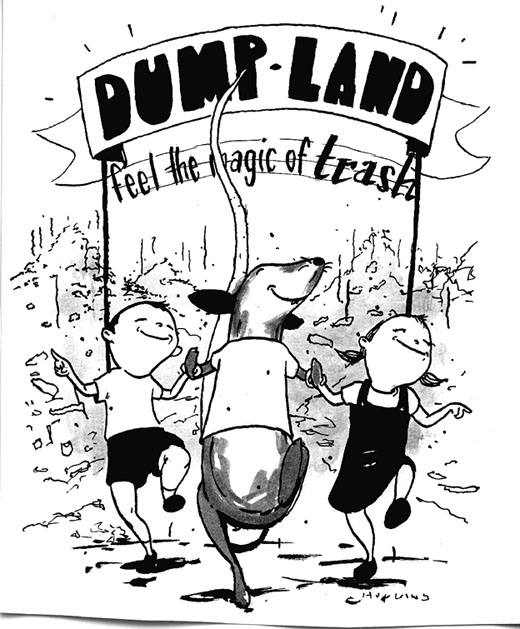
If not for this intervention, Adams Mine, and the fate of the north would have been tainted. A clever way these ‘unlikely radicals’ fought against Metropolitan Toronto Work’s press was through their own artistic skills. Dean Dubois (an illustrator) among others, created many illustrations poking fun at Metro’s absurd ideas, some portraying rats dancing with children, or even large garbage train cars infested with rats and overflowing with needles.
Northern Ontario’s distinct culture, founded in hard times, brought together the north’s English, French and Indigenous communities, in activism, humour, and the love of our home. The ability of these groups to come together showed how necessary it was to put a stop to the landfill proposal.
Music played a key role, as it allowed for a pure expression that transcended boundaries of location and economic status. Charlie Angus and the Grievous Angels were at the center of this protest music scene for Adams Mine, that continued to bring people together, and broke down social barriers between English, French, Indigenous, Protestant, Catholic, Ontarians and Québecois.

Mel the Moose - a giant metal moose sculpture filled with garbage - was a symbol of this resilience, it said “we will not stand idly by and watch you destroy our home, we will fight back.” What is more artistic than wheeling a community sculpture into Parliament?
Civil disobedience comes at a cost, a personal cost. The braveness of those involved, truly, is understated. They were willing to risk their livelihoods or more, to make sure Adams Mine never became a dump site.
Humour as a form of art, allowed this movement to surpass all of the professional PR of Toronto Metro Works. With this perfect blend of coarseness, humour, and love, a small team of community members, which later grew too large to ignore, brought down the big business’s plan to dump 20 million tons of garbage into a northern mine, and would effectively destroy our drinking water, and livelihood. Moving forward, we must not forget the tremendous feats possible when communities come together.
ADAMS MINE TIMELINE
Click timeline photos to view at higher quality


ARCHIVAL MATERIALS
Newspaper articles, letters to the editor, and political cartoons from 1995 to 2000, spanning the most active portions of the Adams Mine protests.
You can either flip through the document above, or Click here to view the PDF in another browser page.

Propaganda created by the Anti-Adams Mine protesters, and the businesses interested in pushing through the Adams Mine Landfill project. Booklet compile from a number of different sources.
News coverage from the Adams Mine protests
John Vanthof's powerpoint presentation from Adams Mine protests with the original working demo model, turned into a video for this project.
Download a copy of the exhibition brochure here. It includes the statements and essay seen above, alongside photographs of the protest and political cartoons featured in the exhibition.
PHOTOS from the Adamsmine.com ARCHIVED WEBSITE










February 20